
)
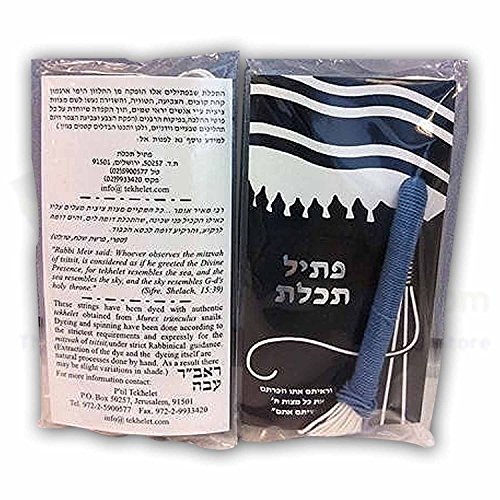
Tzitzit Strings – Ptil Tekhelet – Tosafos Ravad Thick Full Fringes Niputz Lishmah Strings
“Speak to the Children of Israel and bid them that they make fringes on the corners of their garments throughout their generations, and that they put upon the fringe of each corner a thread of blue (tekhelet). And it shall be for you as a fringe, that you may look upon it and remember all
Categories: Tzitzit
$193.75Amazon.com Price
(as of December 4, 2018 5:22 am GMT+0000 - Details)
Added on: December 4, 2018 - More: Comments & Reviews
Product Description
“Speak to the Children of Israel and bid them that they make fringes on the corners of their garments throughout their generations, and that they put upon the fringe of each corner a thread of blue (tekhelet). And it shall be for you as a fringe, that you may look upon it and remember all the commandments of G-d, and do them…” (Numbers 15:38-39)
Our hand made thick “Chareidim” Menupatz Lishmah white tzitzis strings are meant to be tied onto a tallit kattan or tallit gadol. Ideal for longer lasting tzitzis strings! Set is enough for all four corners of the garment.
Niputz is a Chumra/חומרה of having the lishma aspect start one step sooner in the process. Miputz/ניפוץ is a mechanical process that breaks up locks and unorganized clumps of the wool fibre and then aligns the individual fibres so that they are more or less parallel with each other. The Shulhan Aruch (OH 11:1) states that one must have Tevia/טווה Lishma/לשמה and the Rama / Rema notes that some are Machmirin to have Niputz Lishma, though he says the custom is to be lenient. The Mishna Berura (OH 11:3) explains that the mitzvah of making tzitzit Taaseh Lecha Gedilim / תעשה לך גדילים starts with the Tevia, however, he notes that the Prisha states in the name of the Maharal of Prague that Lechathila one should be strict and use Niputz Lishma. The Aruch HaShulhan (OH 11:4) explains the Maharal’s reasoning is that Taaseh Lecha Gedilim / תעשה לך גדילים is stated in conjunction with Shatnez/שעטנז, and the making of Shatnez includes the act of Niputz, so one needs Lishma at this level of the process. The Aruch Hashulhan thus concludes that one should be careful with this.
According to the Talmud, the dye of Tekhelet was produced from a marine creature known as the Ḥillazon (also spelled Chilazon).[2] According to the Tosefta (Men. 9:6), the Ḥillazon is the exclusive source of the dye.
Product Features
- BLUE TCHEILES STRINGS! Kosher white strings – our exclusive item with an added enhancement! The strings have been hand spun (menupatz lishmah).
- READY MADE! Place these ready made thick tzitzits strings on your tallit katan garment.
- THICK TZITZIT TASSELS! Our hand made thick “Chareidim” Menupatz Lishmah white tzitzis strings are meant to be tied onto a tallit kattan or tallit gadol. Ideal for longer lasting tzitzis strings! Set is enough for all four corners of the garment.
- FULFILL A BIBLICAL COMMAND WITH THESE JEWISH FRINGES! One should always be heedful of the commandment to wear tsitsit, for the Torah equated and connected all other mitzvot with it, as it is written ‘And you shall see it and remember all of the commandments of Hashem and you shall do them.’ (Rambam, Hil. Tsitsit, 3;13)
- PERFECT FOR JEWISH MEN AND BOYS! Wool strings have the blue tekhelet dye!
Lysol Disinfectant Spray, Crisp Linen, 38oz (2X19oz)... [Read More]

Clorox Disinfecting Wipes Variety Pack – 5 Pack, 390 C... [Read More]

OasisSpace Upright Walker – Tall Walker with 10″... [Read More]

Sumind 30 Pack Slingshot Chicken Rubber Chicken Flick Chicke... [Read More]

Party master Purple Shadow Freddy Bear Exclusive Collectible... [Read More]

5 Pack: Big Boys Youth Clothing Knit Mesh Active Athletic Pe... [Read More]

The Children’s Place Big Boys’ Bootcut Jeans, Du... [Read More]

Levi’s Boys’ Big 514 Straight Fit Jeans, Covered... [Read More]

The Children’s Place Big Boys’ Pull-on Cargo Sho... [Read More]

Creativity for Kids Glow In The Dark Rock Painting Kit ̵... [Read More]
