
)
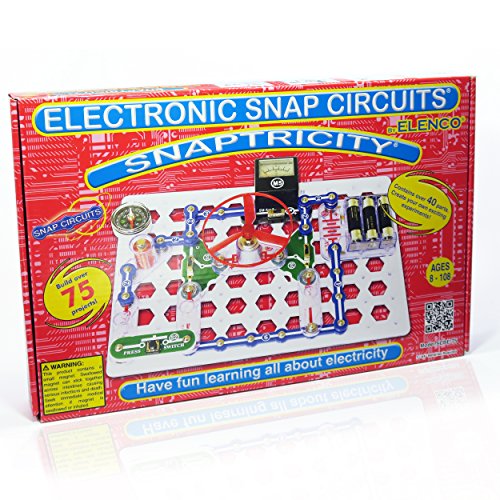
Snap Circuits Snaptricity Electronics Discovery Kit
Following the same experiment pattern of other Snap Circuits kits, Snaptricity teaches you how electricity and magnetism work and how they can be used to make each other. Learn about magnetic fields, how the electricity in your home works, how switches control the electricity to the lights in your home, and how series and parallel
Categories: Kids Electronics
$30.99Amazon.com Price
(as of April 20, 2020 1:09 am GMT+0000 - Details)
Added on: September 28, 2017 - More: Comments & Reviews
Product Description
Following the same experiment pattern of other Snap Circuits kits, Snaptricity teaches you how electricity and magnetism work and how they can be used to make each other. Learn about magnetic fields, how the electricity in your home works, how switches control the electricity to the lights in your home, and how series and parallel circuits affect electricity. Snaptricity uses the same “snap” connectors of Snap Circuits to bring electricity and magnetism theories into the practical home.
Product Features
- Build over 75 projects
- Projects relate to electricity and magnetism and how they are used in the home
- Includes: meter, electromagnet, motor, lamps, switches, fan, compass, and electrodes
- Includes 40+ parts
- From Elenco Electronics, the same company that brought you snap Circuits
Write a comment
Lysol Disinfectant Spray, Crisp Linen, 38oz (2X19oz)... [Read More]

Clorox Disinfecting Wipes Variety Pack – 5 Pack, 390 C... [Read More]

OasisSpace Upright Walker – Tall Walker with 10″... [Read More]

Sumind 30 Pack Slingshot Chicken Rubber Chicken Flick Chicke... [Read More]

BEYOUR WALKER Upright Rollator Walker Euro Style Stand Up Wa... [Read More]

5 Pack: Big Boys Youth Clothing Knit Mesh Active Athletic Pe... [Read More]

The Children’s Place Big Boys’ Bootcut Jeans, Du... [Read More]

Levi’s Boys’ Big 514 Straight Fit Jeans, Covered... [Read More]

The Children’s Place Big Boys’ Pull-on Cargo Sho... [Read More]

Creativity for Kids Glow In The Dark Rock Painting Kit ̵... [Read More]

super Initially I bought Snap-Circuits for my 4 and 5 year old boys. I found the collection of capacitors, resistors, integrated circuit modules, and transistors was a little too abstract, and I was thinking I really wanted more stuff like electro-magnets, relays, motors, generators, switches, potentiometers, and maybe resistive loads like light bulbs and diodes — more basic electrical stuff, of which there’s some in the circuit kits but not a lot.
It is a nice starter kit to get your kids in on electrical … It is a nice starter kit to get your kids in on electrical circuits and the like. The projects are nice – some are repetitions with minor circuit modifications. Dont expect your kids to do all 70+ of them. If you get to around half that itself the kit is a success. It does provide hours of experimental learning time. Some – an adult will be needed. UNderstanding some circuits do take some time. the picture is not very descriptive of how to get it done using the available parts – at least the…
I bought this for my nephew I really enjoyed playing with this toy before I gave it to my nephew. It has some really intriguing experiments. The motor spins backwards and forwards depending on how the electricity is sent to it. The cool thing is that you can run the fan backwards so it doesn’t fly away first, then reverse polarity and it flys off.